Founded on the 4th of August, 1964, Vanguard have for decades been entrusted with the handling and storage of the nations high-value treasures, businesses irreplaceable machinery, and peoples personal effects and heirlooms.

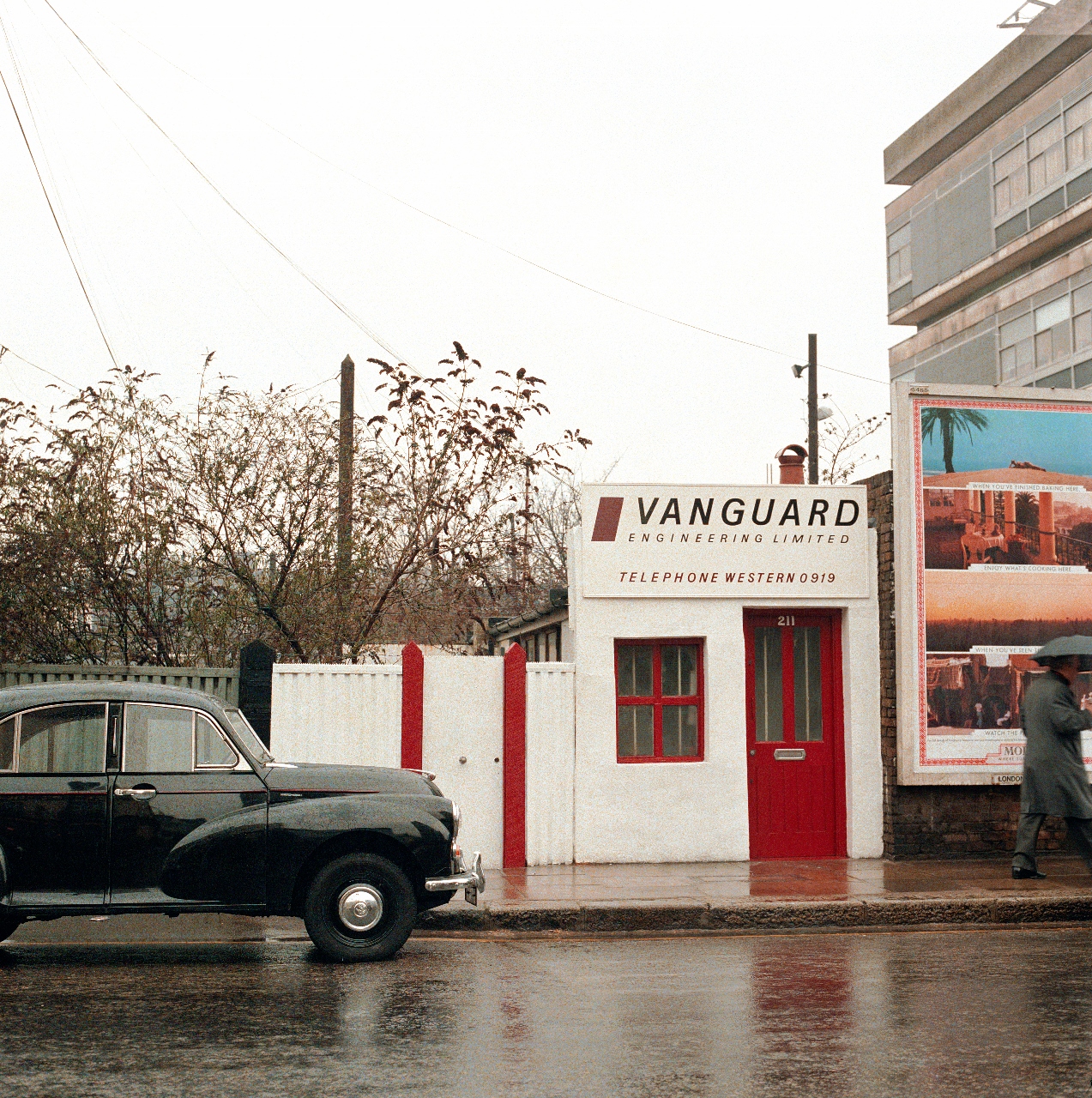
This is 211 Warwick Road W14 which was Vanguards very first office. It was an ex-BR weighbridge hut which Vanguard rented from the Western Region of British Railways for £150 per annum.
On a hot Sunday, 3rd August 1964, the day before Vanguard started trading, Eddie McCormack, Ian Sandeberg and Mac McCullagh, together with Diane Brooks and Carole Maxey (their secretaries at Beck & Pollitzer where they had all previously worked) painted the whole of the 18ft x 8ft wide building inside and out and by mid-day were enjoying a well-earned al-fresco pint immediately across the road outside the Warwick Arms.
They watched a very drunken individual weave his way up the pavement on the opposite side of the busy road and all became concerned when he stopped outside this door, the door of their pristine little office, undid his flies and it dawned on the team what he was about to do. They all became incandescent when they saw him flip open and pee through the letter box but there was nothing they could do the fast flowing traffic precluded immediate intervention. He had time to empty what he had to do and seconds later had his ears filled with every accusation and threat under the sun. He was as Irish as they come and apologised profusely, explaining: Bajeezus, I didnt know the wee building was occupied. I have been using that as a relief point after I leave the Pembroke Arms and before I reach the Radnor Arms and I promise never to do that again.
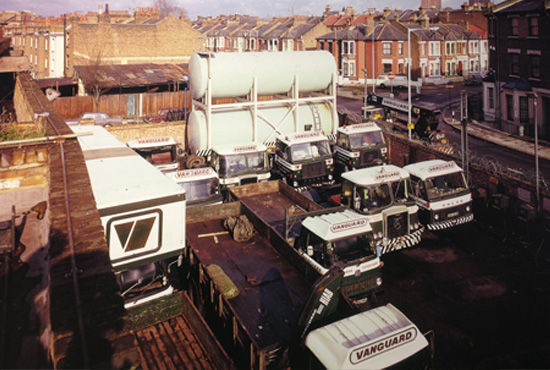
By 1967 Vanguard was flat out, seven days a week, working for many of Londons leading printing companies, breweries and soft drinks companies, plus a whole range of engineering firms. There was no way they could cope with the volume of work from their small rented office and depot in Warwick Road and consequently they decided to start looking for their own freehold depot. Only half a mile away, behind Olympia in Blythe Road W14, they found the Swan Laundry, premises ideally suited to their needs.The freehold asking price was sixty thousand pounds and within a week, thanks to a generous loan repaid within three years, the ex-laundry premises had become the first freehold rung on the Vanguard property ladder.
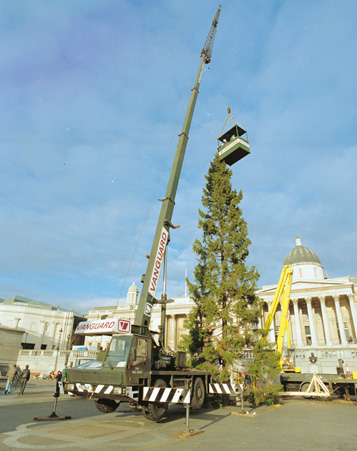
For almost two decades, Vanguard provided free transport from Felixstowe Docks, temporary, secure storage at Western Avenue, delivery to Central London and an early morning crew and crane to plant the focal point of the Capitals festivities, the Trafalgar Square Christmas Tree. The Tree is an annual gift from the people of the City of Oslo to Britain for help given to them during the dark days of Nazi occupation during the Second World War.
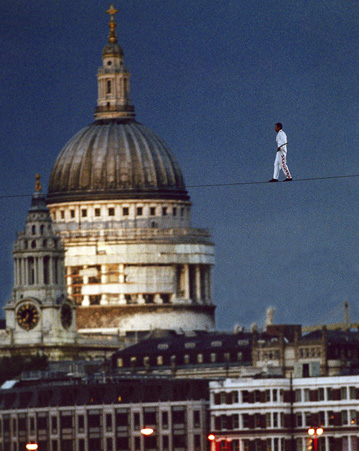
In 1972, Vanguard provided expertise for the second-ever tightrope walk across the River Thames, by German dare-devil Franz Burbach. Franz’s greatest ambition was to be the first man to tightrope across the River Thames. He had the ability, and the courage. but lacked the technical expertise and equipment to rig his rope. He contacted Vanguard for advice and to his relief they confidently replied “no problem”.
Two suitable warehouses were chosen – on the north bank in the City of London, Bull Wharf; on the south bank – Bear Wharf, Southwark. We calculated the stresses to be superimposed on both buildings and by a complicated series of pulley blocks and winches were able to safely distribute the strain throughout the structures. In 1997, we were called on to assist with another attempt, this time by a double-act, Didier Pasquette and Jade Kinder Martin. We anchored each end of the steel tightrope to two 120-ton cranes, then used winches to apply the final tension to the tightrope for their record-breaking event.
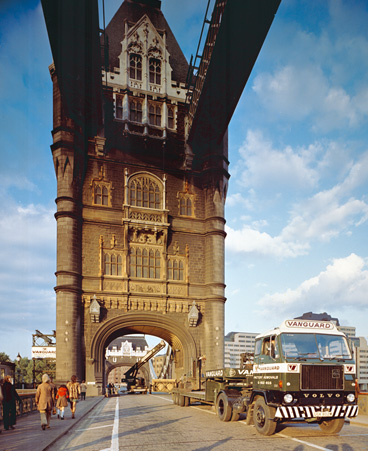
During the modernisation of Londons most famous bridge, Vanguard electrically disconnected, mechanically dismantled and removed for storage the Victorian hydraulic engines that were used to raise and lower the bridge, together with their 110-ton cast-iron accumulators. Also removed were the 100-person capacity hydraulic lifts by which pedestrians had crossed the bridge while the bascules were in the raised position.
When the bridge first opened in 1894, there was so much river traffic the 1800-ton bascules spent most of the day raised. The only way for pedestrians to cross was either to travel in the 100-person lifts up to high level, walk across the foot bridge and down the lifts on the other side or walk up through the oak staircases to the top. The bridge structure was heated by gas throughout, consequently all the nooks and crannies and alcoves on either side of the staircase invited courting couples. The footbridge, 110 feet above road level, was the chosen location for suicides. Within two years of opening the bridge, Parliament announced that the British Public could not be trusted. They were both conceiving and killing themselves and that put paid to the lifts, the staircases and the footbridge for the next 90 years until 1989 when Parliament decided the public had better places for their activities and re-opened the bridge to the public.
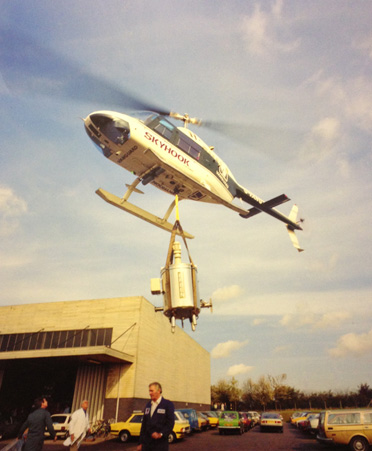
Vanguard always maintained a policy of embracing new technology and methods in their own industry and in 1982 formed Skyhook Lifting Limited, specialising in the installation of plant by helicopter on the top of high-rise buildings in city-centre locations, inaccessible to conventional cranage. Here, Skyhooks own JetRanger helicopter provides hook-up training for Vanguard personnel.
In what was possibly the most valuable and time critical move of heavy printing machinery ever undertaken, Vanguards Transport Division collected 18,800 tons of MAN presses, valued at a massive $US450million, transported from Man Roland Druckmaschinen AG in Augsburg Germany to Wapping, East London, Knowsley near Liverpool and Glasgow, offloaded and completed the mechanical and electrical installation in conjunction with MAN engineers. Every press was installed ahead of schedule, completely damage free with not even the paint scratched. This photograph shows the last of the 32 thirty-one-tonne printing unit being placed at Wapping.
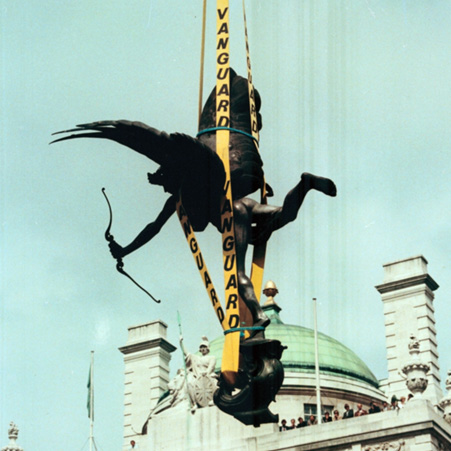
Vanguard carefully dismantled Eros, Londons best known statue, and his supporting Shaftesbury Memorial Fountain, packed them up and shipped them north of the Border to Scotland where they were meticulously renovated by Edinburgh firm of Charles Henshaw & Sons, the company that originally cast Eros in 1893. A year later, looking as good as new, we re-installed Eros and the Fountain back to their rightful pace in Piccadilly Circus.
Early in 1990, Vanguard showed off a selection of our heavy plant and equipment at the International Construction Equipment Exhibition at Wembley. On display were Vanguards 50-ton Boom Truck and 600-ton capacity gantry and the spectacular icing on the top of our heavy lift cake was our own Hawker Hunter, WT555, the very first production aircraft, once flown by Neville Duke and presented by him to the Duke of Edinburgh who received it on behalf of the RAF and whose shield is still on the nose of the aircraft. We purchased WT555 in 1989 and periodically by popular demand it appears on the roof of our building on the Western Avenue, Greenford.
The Horses of Helios are four bronze horses, 1½ times life size, that Vanguard installed in an alcove in the corner of the Haymarket and Piccadilly. Forced by restricted headroom to find an alternative method to a conventional crane, we designed and constructed a specially 12-metre long extension to the jib of our 50-ton capacity Boom Truck, to position the sculptures. Two of the bronze horses cast together weighed three tons and the height of the fountain and low headroom demanded rigging skills of the highest order. On the roof above the Horses we positioned the Three Graces, each a double-life sized beautiful, naked, gold-covered young woman diving into space.
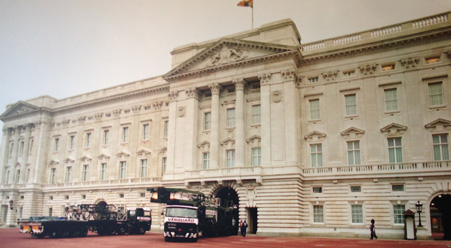
Vanguard were contracted to dismantle and remove existing air conditioning plant from the roof of the south west wing of Buckingham Palace and on the same day re-install the new air conditioning plant but were advised that the work could not be undertaken if the Queen was in residence. On the chosen day, their team and huge GCI mobile tower crane arrived at the Palace at 0600 hours to find the Royal Ensign flying signifying the Queen was in residence. All permissions had been granted, all the systems were in place and it was too late to cancel the project and so Vanguard were asked to keep the noise to a minimum.
As planned, the huge crane reduced tyre pressure and literally crept under the arch with 10mm to spare. Once in the courtyard it was erected to its full height, enabling it to lift to a height of 100 metres at a radius of 55. Vanguard immediately started work only to find they were the only act in a Royal Command Performance. Every ½ hour, one of the Queens household would appear and initially advised their team that the Queen and the Duke of Edinburgh were most interested in the performance and had a running commentary for each act. Vanguards foreman received the Royal runner at regular intervals throughout the day explaining the action, namely, Act 1, the removal of the old plant and its transport off site, Act 2, preparing the vacated area to receive the new plant, Act 3, lifting the new plant to site, Act 4, assembling the new plant, Act 5, derigging and dismantling the crane and leaving the courtyard via that tight tunnel. t is understood Her Majesty and the Duke of Edinburgh were delighted by the performance and impressed by Vanguards grit and determination. It poured down all day yet the work was completed exactly as scheduled.
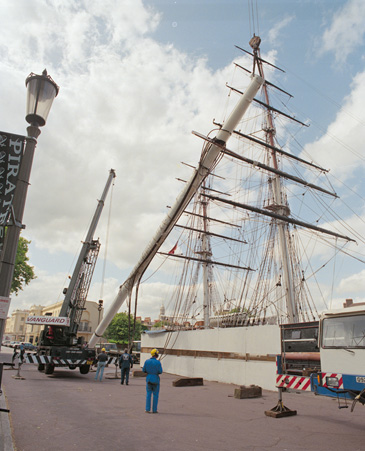
To mark the start of a major public appeal for £2m to save Greenwichs most famous landmark, Vanguard gave the Cutty Sark a facelift when we swapped the last of the original ships masts with a new one, 85 feet long and weighing 8 tons. Two cranes, one 25-ton and one 90-ton, were used to perform a tandem lift, watched by celebrated yachtsman, Robin Knox-Johnston, who launched the appeal.
2021 Vanguard Filebank
